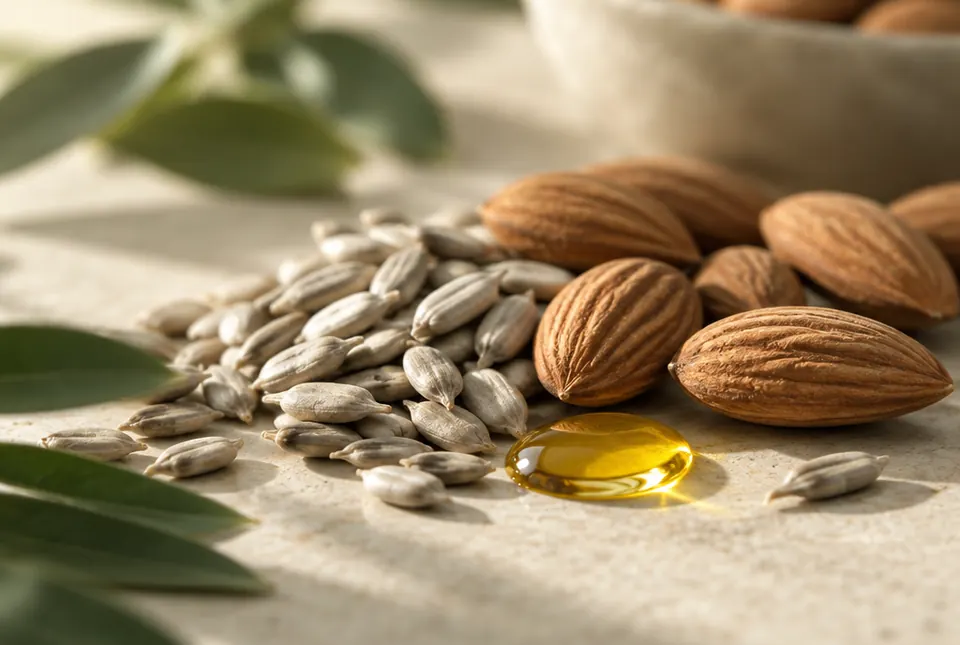
Vitamin E is a fat-soluble antioxidant vitamin. The richest sources are plant oils such as rapeseed, sunflower, soya, corn and olive oil, along with nuts, seeds and wheatgerm. Wheatgerm is found in cereals and cereal products, which also contribute. Any vitamin E your body does not need straight away is stored for future use, so you do not need it in your diet every day.
Vitamin E contributes to the protection of cells from oxidative stress. This is the authorised description of its role, and it is why vitamin E often appears in antioxidant blends alongside vitamin C and selenium.
Vitamin E is a family of related compounds, and labels can look confusing. Natural vitamin E is usually written as d-alpha-tocopherol, while synthetic vitamin E is dl-alpha-tocopherol. You may also see esters such as tocopheryl acetate or tocopheryl succinate, or mixed tocopherols. Amounts are given in milligrams (mg) or international units (IU), and natural and synthetic IU are not equivalent, so the milligram figure is the easiest way to compare products.