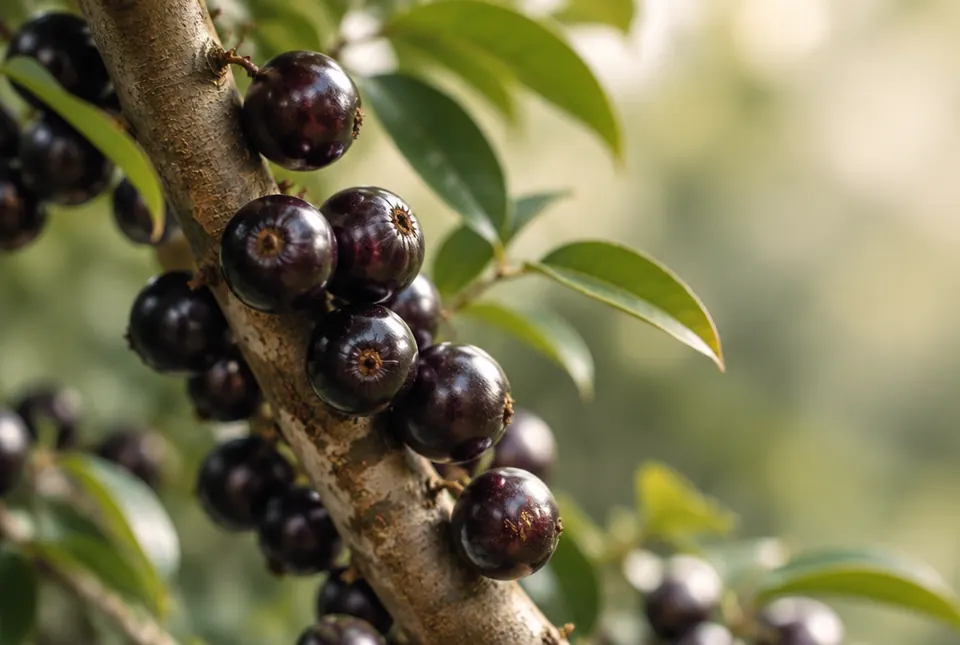
Jaboticaba (Plinia cauliflora, also known as Myrciaria cauliflora) is one of the most striking fruit trees in the world. Native to the Atlantic Rainforest of Brazil, it produces its dark purple, grape-like berries directly on the trunk and branches rather than on new shoots, so a fruiting tree looks as if it has been studded with marbles.
In Brazil the fruit is eaten fresh and made into jams, juices and other food products, and the leaves and peel have a place in traditional indigenous practice. The thick, almost black skin is where most of the goodness lies. It is rich in anthocyanin antioxidants, mainly cyanidin-3-glucoside and delphinidin-3-glucoside, alongside ellagitannins, ellagic acid and gallic acid. On supplement labels you may see jaboticaba fruit or peel powder, or jaboticaba extract.
Laboratory and animal studies have explored the antioxidant and anti-inflammatory activity of jaboticaba polyphenols, and a few small human studies have looked at markers such as blood sugar response and inflammation. A 2021 review of around 200 published articles concluded that more research in people is still needed to understand how jaboticaba polyphenols work in the body.