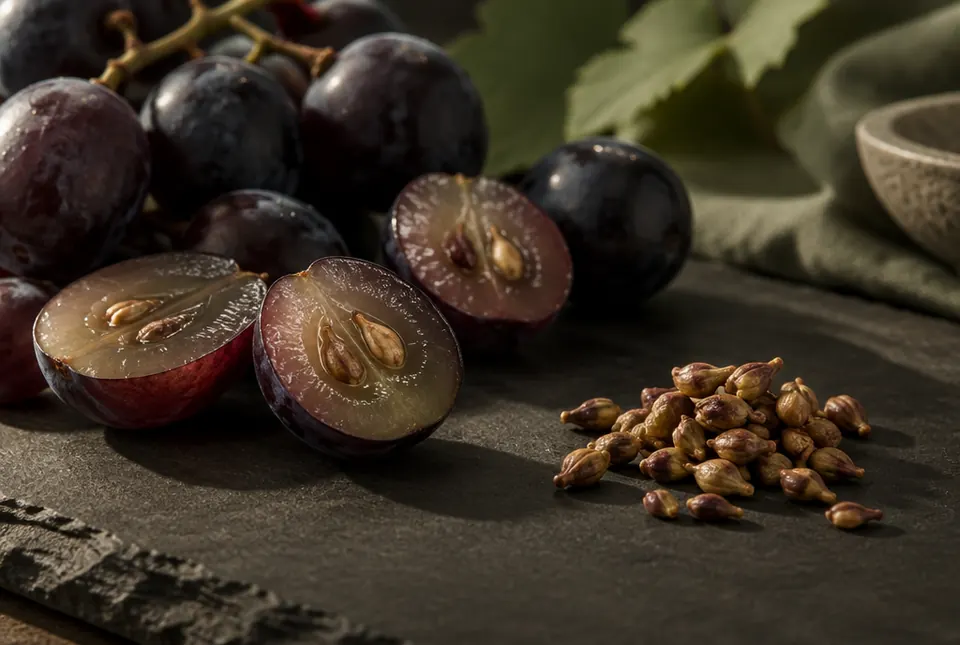
Grape seed extract is made from the seeds of wine grapes, Vitis vinifera, usually collected as a by-product of winemaking. The seeds are ground, extracted and dried into a fine reddish-brown powder that is rich in proanthocyanidins, a group of polyphenols also found in red wine, cocoa, apples and berries.
Proanthocyanidins are sometimes called OPCs, short for oligomeric proanthocyanidins. They are one of the reasons red grapes and red wine have attracted so much research interest. Researchers have studied grape seed extract in small trials looking at circulation and blood pressure, but the evidence is still mixed and it has no authorised health claim.
On labels you will see grape seed extract, Vitis vinifera seed extract, OPCs or proanthocyanidins, often with a percentage such as 95% that describes how standardised the extract is. That figure matters more than the headline milligram weight, because extracts with the same weight can contain very different amounts of OPCs.