Free US delivery over $250
Nutra Formulations
Oils for hair and skin

Jojoba oil

A liquid wax pressed from jojoba seeds, close to the skin’s own oil.

Why it’s used: Conditions hair and skin without feeling greasy.

Shop 1 product with jojoba oil
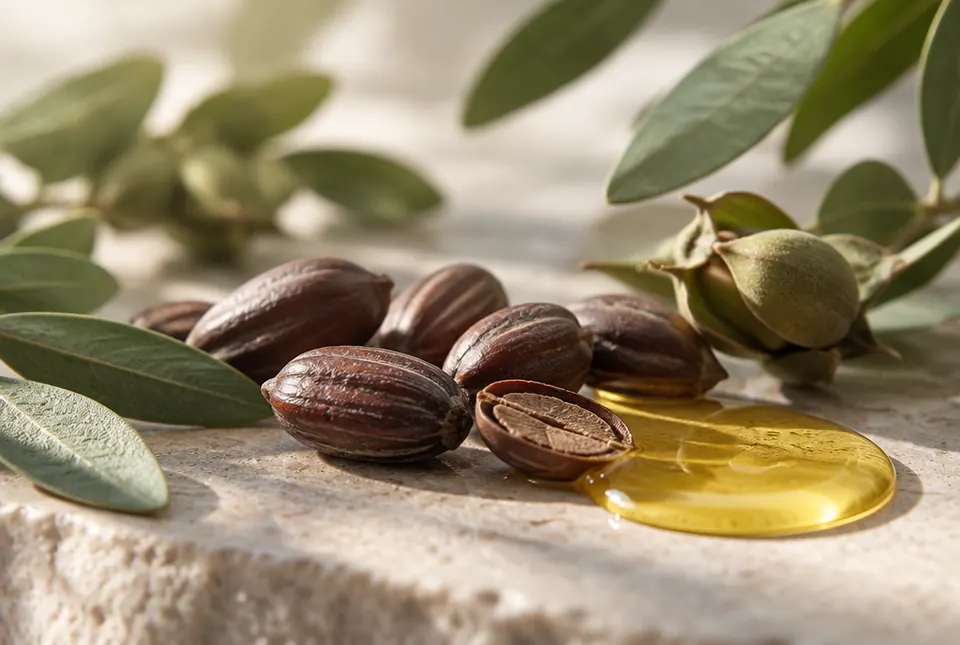
jojoba seeds and golden oil
About

What is jojoba oil?

Jojoba (Simmondsia chinensis, pronounced ho-HO-ba) is a hardy, grey-green shrub native to the deserts of the south-western United States and northern Mexico. Its seeds are cold-pressed to produce a golden liquid that is usually called an oil but is actually a liquid wax, making up roughly half the weight of the seed. Jojoba is the only plant known to produce liquid wax in this way.

Around 98% of jojoba oil is made up of wax esters, with small amounts of free fatty acids, fatty alcohols, sterols and vitamin E. What makes it so popular in hair and skin care is that these wax esters closely resemble the wax esters in human sebum, the skin's own oil. On ingredient lists you will see Simmondsia chinensis seed oil, and it is a favourite carrier oil for blending essential oils such as rosemary.

Jojoba oil conditions hair and skin without feeling greasy. Studies describe it as a light, lubricating emollient that softens the skin surface and helps reduce water loss without blocking the skin, and research shows it mainly stays in the outermost layers of the skin. It has been used in cosmetics since the 1970s, when it became a replacement for sperm whale oil.

What the research says

Evidence, not anecdote.

2 findings behind this ingredient. Hover a card for the detail and the source.

RCT2008

Adding hydrolysed jojoba esters to a glycerol lotion reduced skin water loss for up to 24 hours compared with glycerol alone.

A small pilot study applied lotions to the lower legs of volunteers. The formula with 3.75% glycerol and 1.25% hydrolysed jojoba esters gave significantly lower transepidermal water loss than glycerol alone at 8 and 24 hours.

Observational2012

A clay and jojoba oil face mask used two to three times weekly was linked to fewer blemishes in mild acne.

In an open, uncontrolled pilot study, 194 people with acne-prone skin used the mask 2 to 3 times a week for six weeks. Among 133 with complete records, total lesion count fell by 54% from baseline.

In our range

Supplements with jojoba oil.

Questions

Asked before you buy.

Can't see yours? Ask our team, answered within a working day.

Is jojoba oil actually an oil?

Not technically. Jojoba is a liquid wax made almost entirely of wax esters, rather than the triglycerides found in most plant oils. That structure gives it a light, non-greasy feel that is close to the skin's own oil.

Why is jojoba oil good for hair and skin?

Its wax esters closely resemble those in sebum, the oil your skin makes naturally. It conditions hair and skin without feeling greasy, softens the skin surface and helps reduce moisture loss without blocking the skin.

Can jojoba oil be used as a carrier oil?

Yes. Jojoba is one of the most popular carrier oils because it is light and spreads easily without a greasy feel. It is often used to dilute essential oils such as rosemary before applying them to the scalp or skin.

Shop by goal
Often found with
Independent experts

Experts on jojoba oil.

Videos from doctors, research scientists and registered dietitians, for general education. They are independent of Nutra Formulations, do not refer to our products and are not medical advice for you.

Jojoba Oil for Skin and Hair

Dr Andrea Suarez (Dr Dray), MD, board-certified dermatologist · Dr Dray on YouTube

Sources
  1. Jojoba Oil: An Updated Comprehensive Review on Chemistry, Pharmaceutical Uses, and Toxicity · Polymers (PubMed Central), 2021
  2. Acute Effects of Transdermal Administration of Jojoba Oil on Lipid Metabolism in Mice · Medicina (PubMed Central), 2019
  3. Anti-Inflammatory and Skin Barrier Repair Effects of Topical Application of Some Plant Oils · International Journal of Molecular Sciences (PubMed Central), 2017

Information only, not medical advice. If you take medication, are pregnant or breastfeeding, speak to your GP or pharmacist first.

Find your protocol

Not sure where to start?

Six quick questions match you to the products in our range that fit your goal, with the reasons why.

Start the assessment