
Safflower
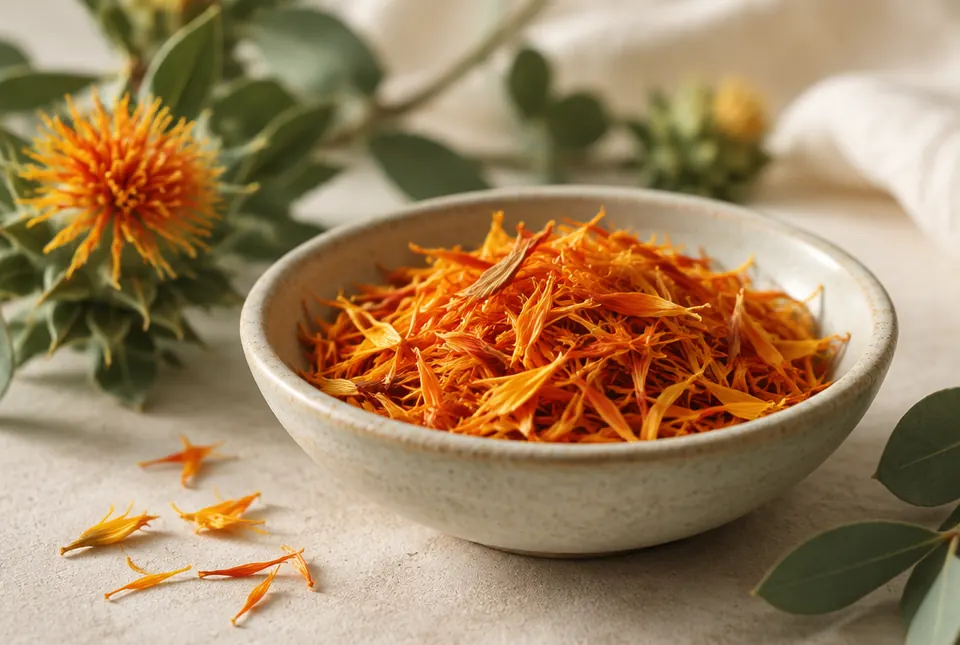
Petals of the safflower plant.
Why it’s used: Traditionally used to support circulation.
What is safflower?
Safflower (Carthamus tinctorius) is a thistle-like plant with bright orange and yellow flowers, grown since ancient times across the Middle East, India and China. Its seeds are pressed for the familiar cooking oil, while its petals were long used as a natural dye for fabric and food.
In traditional Chinese and Persian practice it is the dried flowers, not the oil, that are used. Known as hong hua in Chinese practice, safflower petals are traditionally used to support circulation. On supplement labels you will see safflower flower, Carthamus tinctorius flower extract or hong hua, usually in herbal blends. Safflower seed oil is a separate ingredient, mainly valued for its fatty acids.
Laboratory and animal studies have found that safflower flower extracts can affect blood flow and platelet activity. These findings explain its traditional reputation, but well-designed trials in people are limited, and the same activity is the reason for its important safety cautions.
Supplements with safflower.
Asked before you buy.
Can't see yours? Ask our team, answered within a working day.
Is safflower flower the same as safflower oil?
No. Safflower oil is pressed from the seeds and is a cooking oil valued for its fats. Supplements traditionally used for circulation contain the dried flowers, which have different compounds and different safety cautions.
Can you take safflower with blood thinners?
It is best not to without medical advice. Safflower flower compounds can affect platelets and blood clotting, so combining them with warfarin, aspirin or similar medicines may raise the risk of bleeding. Speak to your GP or pharmacist first.
Why is safflower not suitable in pregnancy?
Safflower flower has traditionally been used to bring on periods, and animal studies have shown effects on pregnancy and developing young. For that reason it is considered unsafe in pregnancy and should be avoided completely.
- Medical uses of Carthamus tinctorius L. (Safflower): a comprehensive review from Traditional Medicine to Modern Medicine · PubMed Central (Electronic Physician), 2018
- Phytochemistry, pharmacology and medicinal properties of Carthamus tinctorius L. · Chinese Journal of Integrative Medicine (PubMed), 2013
Information only, not medical advice. If you take medication, are pregnant or breastfeeding, speak to your GP or pharmacist first.
Not sure where to start?
Six quick questions match you to the products in our range that fit your goal, with the reasons why.