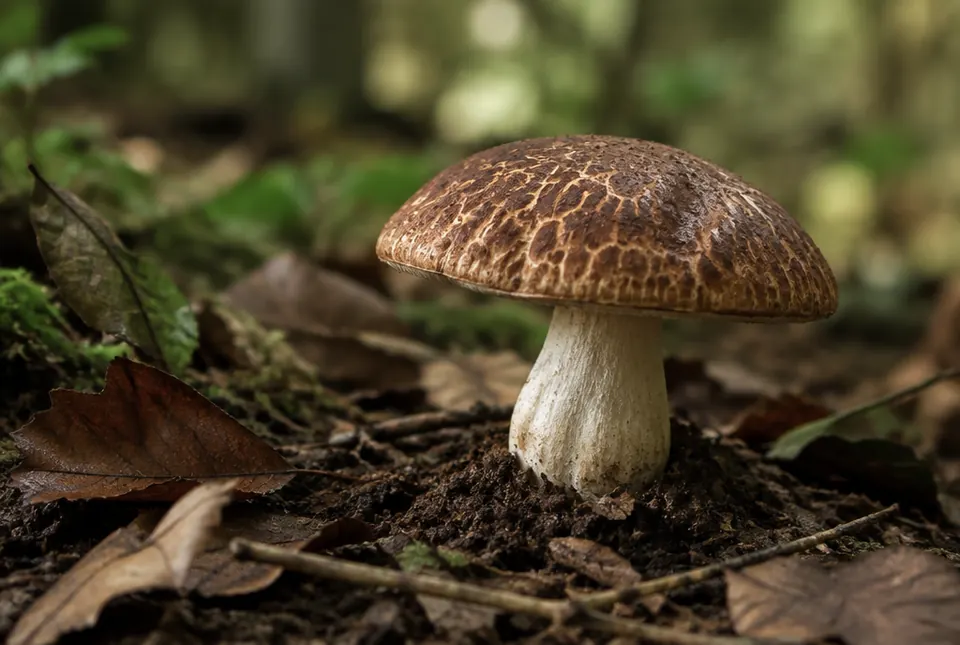
Tiger milk mushroom (Lignosus rhinocerus, also written Lignosus rhinocerotis) is a rare fungus from the rainforests of Malaysia and South-East Asia. The valuable part is the sclerotium, a tuber-like mass that grows underground. Local folklore says the mushroom springs up where a tigress spilt milk while feeding her cubs, and the creamy white sclerotium does look a little like congealed milk.
For generations, indigenous Orang Asli communities including the Semai, Temuan and Jakun have used it as a general tonic and for coughs and breathing, and tiger milk mushroom is traditionally used to support the lungs and breathing. Wild specimens are hard to find, which kept it rare and expensive until growers in Malaysia succeeded in cultivating it. On supplement labels you will usually see tiger milk mushroom, Lignosus rhinocerus sclerotium powder or extract.
Laboratory and animal studies have investigated its antioxidant and airway effects, and safety studies on the cultivated sclerotium in animals found no adverse effects at high doses. A small clinical study in women after breast cancer treatment found it was well tolerated. Human research is still limited, so most of what is known comes from tradition and early-stage studies.